Friday, December 23, 2005


Thursday, December 22, 2005
Body Fat
Body Fat: "Using your measurements of a 31 inches waist and weight of 155 pounds your body fat percentage is estimated to be 12.07 % using the U.S. Navy body fat formula, or 11.30 % using the formula developed by the YMCA."
Not so differnt from the 13% that my Tanita scale reports. So, my goal weight of 145 lbs may be possible. Would really like to be tested hydrostatically to really know what's possible.
Not so differnt from the 13% that my Tanita scale reports. So, my goal weight of 145 lbs may be possible. Would really like to be tested hydrostatically to really know what's possible.
Aerobic Development: Years and Years
"Your aerobic development is a gradual thing. It takes years and years of marathon-type training to develop your aerobic capacity to the fullest."
--Arthur Lydiard
Wednesday, December 21, 2005

Performance Center in Santa Monica
Forster Physical Therapy: "PHASE IV is a scientific training and performance center for athletes of all abilities."
Must be something like this in the Bay Area.
Must be something like this in the Bay Area.
Tuesday, December 20, 2005
Improving Lung Health
Improving Lung Health: "Increased glutathione levels have been shown to IMPROVE LUNG FUNCTION"
Not sure what to make of this. Found out about this stuff on Jim Gilliam's health wiki.
Not sure what to make of this. Found out about this stuff on Jim Gilliam's health wiki.
Monday, December 19, 2005
Why Estimates are Muda
Because it adds no value!! So how can you tell the client when the project will be done when you don't have estimates? Can lead time, WIP, and flow rates be used?
Read more at www.agilemanagement.net...
The Science of Kenyan Eating
Runnning Research News is reporting:
 The Kenyans were ingesting about 10.4 grams of carbohydrate per kilogram of body mass each day, or approximately 4.7 grams per pound of body weight. An amazing facet of the Kenyans'eating habits was the consistency of this carbohydrate intake: Every 24 hours, the Kenyans took in about 600 grams of carbohydrate, with very little variation from day to day. They were truly stocking their leg muscles with glycogen, giving their sinews the right fuel necessary for the high-intensity training they were conducting - and avoiding the fatiguewhich automatically follows on the heels of glycogen wipe-outs....
For me @ 155 lbs, that would equal 728.5 grams of carbs or 2914 kcal. My current diet calls for 1860 kcal (not that I follow this with any rigor).
I wonder if they consume less protein or fat.
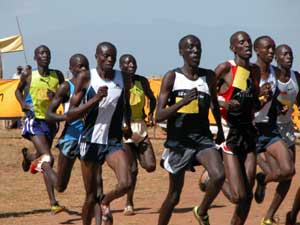 The Kenyans were ingesting about 10.4 grams of carbohydrate per kilogram of body mass each day, or approximately 4.7 grams per pound of body weight. An amazing facet of the Kenyans'eating habits was the consistency of this carbohydrate intake: Every 24 hours, the Kenyans took in about 600 grams of carbohydrate, with very little variation from day to day. They were truly stocking their leg muscles with glycogen, giving their sinews the right fuel necessary for the high-intensity training they were conducting - and avoiding the fatiguewhich automatically follows on the heels of glycogen wipe-outs....
For me @ 155 lbs, that would equal 728.5 grams of carbs or 2914 kcal. My current diet calls for 1860 kcal (not that I follow this with any rigor).
I wonder if they consume less protein or fat.
Sunday, December 18, 2005
Coggan Notes
My highest recorded Normalized Power (NP) for one hour is 271 watts (225 average). This was done Oct. 2nd 2004 during a group ride. During this period it was common for my 1 NP to be ~255. Earlier this month I did 259 during a Saturday ride.
How many times a week should during winter should threshold work be done? I thought the focus of winter training was to raise aerobic capacity (base as they call it)?
Threshold Power == 247-285 which *is* impossible on my trainer.
Threshold workout might consist of:
2 weeks of 2 x 15 @ 260 watts w/ 1 minute rest interval
2 weeks of 3 x 15 @ 260 watts w/ 1 minute rest interval
2 weeks of 2 x 20 @ 260 watts w/ 5 minute rest interval
Coggan did 12 weeks of 2 x 20 and raised his FT.
Coggan Notes
-------------------
There's absolutely nothing magic about 20 min efforts
There's a zillion possible ways inducing the same physiological adaptations:
1) keep the efforts at least 15 min in duration, or
2) keep the rest periods between them very short (i.e., 1 min or less).
For example, for that same hour of training you could do 4 x 15 min or 2 x 30 min instead of 3 x 20 min, or you could do 12 x 5 min/1 min. Or, you could lower the intensity a bit (not a lot) and stretch the duration out to 90-120 min...whatever works for you.
BTW, this morning I did 1 x 30 min at an IF of ~0.9 followed by 4 x 5 min/1 min at an IF of 1.0 (for the on periods). With warm-up and cool-down I got in 50 min of level 4 training and was on and off the trainer in just over 60 min.
Efforts of less than ~15 min duration aren't as effective at raising functional threshold power as longer (e.g., 20+ min) efforts unless you keep the rest period between them very short, so as to basically trick your physiology into thinking it is one continuous effort. As for the total amount of time, you should usually aim for something in the 30-60 min range...less than that, and you aren't doing as much as you could, whereas more than that, you'll probably either have to lower the intensity too much and/or will be too fatigued to train productively the following day. (You could, however, probably do as much as 90 min of level 4 training - e.g., 3 x 30 min - if you kept the intensity at the very bottom of the range. In most cases, though, I think you're better off during such workouts by keeping the intensity a bit higher and hence the duration a bit shorter...if you feel the need to "dig deeper" you can always sandwich the level 4 efforts with plenty of level 2 training, and/or just do an extended level 3 ride.)
Sweet Sport Hypothesis
The sweet spot *hypothesis* can be stated this way: for a given recovery
"cost", you can do so much more level 3 than level 4 that the overall
"dose" of training you can absorb tends to be slightly or somewhat
greater. Keep in mind, however, that this is really just a hypothesis,
and that at some point you have to up the intensity to satisfy the
overload principle.
How many times a week should during winter should threshold work be done? I thought the focus of winter training was to raise aerobic capacity (base as they call it)?
Threshold Power == 247-285 which *is* impossible on my trainer.
Threshold workout might consist of:
2 weeks of 2 x 15 @ 260 watts w/ 1 minute rest interval
2 weeks of 3 x 15 @ 260 watts w/ 1 minute rest interval
2 weeks of 2 x 20 @ 260 watts w/ 5 minute rest interval
Coggan did 12 weeks of 2 x 20 and raised his FT.
Coggan Notes
-------------------
There's absolutely nothing magic about 20 min efforts
There's a zillion possible ways inducing the same physiological adaptations:
1) keep the efforts at least 15 min in duration, or
2) keep the rest periods between them very short (i.e., 1 min or less).
For example, for that same hour of training you could do 4 x 15 min or 2 x 30 min instead of 3 x 20 min, or you could do 12 x 5 min/1 min. Or, you could lower the intensity a bit (not a lot) and stretch the duration out to 90-120 min...whatever works for you.
BTW, this morning I did 1 x 30 min at an IF of ~0.9 followed by 4 x 5 min/1 min at an IF of 1.0 (for the on periods). With warm-up and cool-down I got in 50 min of level 4 training and was on and off the trainer in just over 60 min.
Efforts of less than ~15 min duration aren't as effective at raising functional threshold power as longer (e.g., 20+ min) efforts unless you keep the rest period between them very short, so as to basically trick your physiology into thinking it is one continuous effort. As for the total amount of time, you should usually aim for something in the 30-60 min range...less than that, and you aren't doing as much as you could, whereas more than that, you'll probably either have to lower the intensity too much and/or will be too fatigued to train productively the following day. (You could, however, probably do as much as 90 min of level 4 training - e.g., 3 x 30 min - if you kept the intensity at the very bottom of the range. In most cases, though, I think you're better off during such workouts by keeping the intensity a bit higher and hence the duration a bit shorter...if you feel the need to "dig deeper" you can always sandwich the level 4 efforts with plenty of level 2 training, and/or just do an extended level 3 ride.)
Sweet Sport Hypothesis
The sweet spot *hypothesis* can be stated this way: for a given recovery
"cost", you can do so much more level 3 than level 4 that the overall
"dose" of training you can absorb tends to be slightly or somewhat
greater. Keep in mind, however, that this is really just a hypothesis,
and that at some point you have to up the intensity to satisfy the
overload principle.
Lungs
Vitamin D ' may be the key for healthy lungs but Lung function is not the weak link in endurance performance.
Saturday, December 17, 2005
Quadrant Analysis
Note to self: Read Dr. Coggan's Quadrant Analysis paper. I sure wish he would start a blog.
I find the light and work it, work it, work it.
Bicycle Lights and Generators: "Schmidt Nabendynamo"
I find the light and work it, work it, work it.
-- Janice Dickinson
I find the light and work it, work it, work it.
-- Janice Dickinson
10/2004 - 12/2005
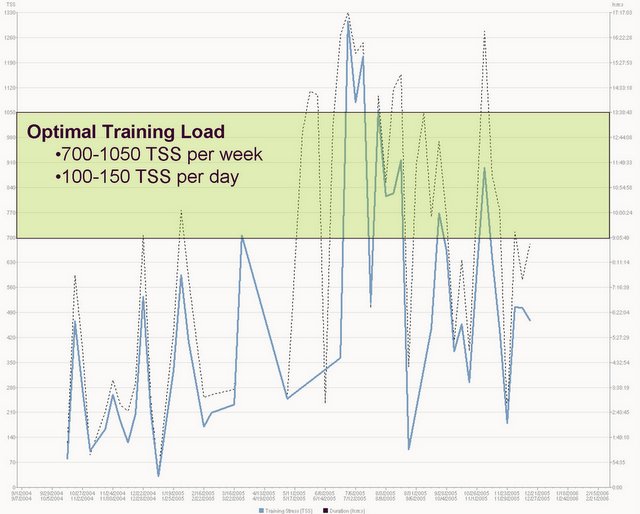
Andrew Coggan writes: Optimum weekly TSS for IM - The Tri Forum: "W/o going into all the details, caveats, etc., based on feedback from beta testers of 'TSTWKT' somewhere in the range of 100-150 TSS/d, or 700-1050 TSS/wk, seems to represent the optimal training load, at least for most people."
So, here's a chart w/ depicting my TSS (the solid line) and my ride Volume (dshed line) since October of 2004. This is loose approximation because the values used for my Functional Threshold have been sketchy and there have been several occasions where I was unable to record a ride.


So, here's a chart w/ depicting my TSS (the solid line) and my ride Volume (dshed line) since October of 2004. This is loose approximation because the values used for my Functional Threshold have been sketchy and there have been several occasions where I was unable to record a ride.

Optimum weekly TSS for IM - The Tri Forum
Andrew Coggan writes: Optimum weekly TSS for IM - The Tri Forum: "W/o going into all the details, caveats, etc., based on feedback from beta testers of 'TSTWKT' (see: http://www.pezcyclingnews.com/?pg=fullstory&id=3331) somewhere in the range of 100-150 TSS/d, or 700-1050 TSS/wk, seems to represent the optimal training load, at least for most people."
Thursday, December 15, 2005

Someone set up us the bonk!
Feeling much better today. The morning treadmill session went well (7 miles) and my case of DOMS has improved significantly. It's too bad that I missed my long run this week but you live and learn. So, what did I learn?
- The long run is critical and needs to be the focus of my run program. I can't let other runs interfere with my ability to perform my long run. I need to fresh, focused, and fueled.
- I must fuel properly to train at an increasingly volume. My "bonk" cycle looks like this: put in a big day, eat little, repeat until I freak out and my body stops responding.
- My body wants to train at the same time everyday. When I switched my daily run to the early morning, my pace slowed and my ability to focus vanished. After 3 days, I seem to be adjusting.
- Lifting weights should be done w/ caution. Duh!
- When I feel sluggish and tired, it's time for a recovery ride.
Wednesday, December 14, 2005
Online Sports Nutrition Journal
More info to chew on. What a day. Will the flood of information every end. I'm starting to think that success in the information age will be determined by attention span.
Anyway. Here's an abstract about the JISSN.
Anyway. Here's an abstract about the JISSN.
Welcome to Sports Nutrition Society: "The Journal of the International Society of Sports Nutrition (JISSN), formerly known as the Sports Nutrition Review Journal, is a peer-reviewed journal that covers various aspects of sports nutrition, supplementation, exercise metabolism, and/or scientific policies related to sports nutrition. "
Attention Economics
Herbert Simon:
"Attention economics is an approach to the management of information that treats human attention as a scarce commodity, and applies economic theory to solve various information management problems."
"...many designers of information systems incorrectly represented their design problem as information scarcity rather than attention scarcity, and as a result they built systems that excelled at providing more and more information to people, when what was really needed were systems that excelled at filtering out unimportant or irrelevant information."
"Attention economics is an approach to the management of information that treats human attention as a scarce commodity, and applies economic theory to solve various information management problems."
"...many designers of information systems incorrectly represented their design problem as information scarcity rather than attention scarcity, and as a result they built systems that excelled at providing more and more information to people, when what was really needed were systems that excelled at filtering out unimportant or irrelevant information."
Tuesday, December 13, 2005
gBlog: Choose Wisely
gBlog: Choose Wisely: "Molina once told me that was the great thing about triathlon -- you truly can out work your competition. My experience is that it's the way in most things, providing we define success correctly."
Music to my ears! I really hope this is true because my genes suck!
Music to my ears! I really hope this is true because my genes suck!
Sunday, July 10, 2005

Thursday, July 07, 2005
Tuesday, July 05, 2005
Training Stress Score

Cycling Peaks gave yesterday's ride a TSS of 504. Looks like today is a recovery day.
Wednesday, June 29, 2005
Seven Deadly Sins
From Andy Coggan:
Seven deadly sins...er, ways of determining your functional threshold power (roughly in
order of increasing certainty):
1) from inspection of a ride file.
2) from power distribution profile from multiple rides.
3) from blood lactate measurements (better or worse, depending on how it
is done).
4) based on normalized power from a hard ~1 h race.
5) using critical power testing and analysis.
6) from the power that you can routinely generate during long intervals
done in training.
7) from the average power during a ~1 h TT (the best predictor of
performance is performance itself).
Note the key words "hard", "routinely", and "average" in methods 4, 6,
and 7...
Monday, June 27, 2005

Bik Schedule
Monday 1.5 hours
1.5 @ < 200
Tuesday 2.0 hours
3 * 8’ on the flats @ 225-235 watts
6 * 2’ SFR w/ 2-2.5’ of Rest. Every week add 30” until 6 * 5’
Wednesday 3 Hours
Flats
30’ warmup @ 3 * 15’ @ ME (225 - 235) 95 rpm
1 * 20’ @ LE (200 - 225) 100 rpm
Hills
2 * 15 @ (200-220) 80 rpm
4 * 5 @ (250-260) 75-80 rpm w/ 5-8 min of rest
Thursday 1.5 Hours
< 200 watts
Friday 1.5 Hours
< 200 watts
Saturday
Group Ride
1 hour < 200 watts
Flats
Hills
Wednesday, May 04, 2005
Sunday, April 10, 2005

Tuesday, April 05, 2005
Sunday, April 03, 2005
Tour of Flanders

Here's a toast to Tom Boonen's victory at tour of Flanders. Now, I suggest that you, dear reader, don't do what I am doing; imbibing heavy drink after two days of heavy training.

Subscribe to:
Posts (Atom)